
The Future of U.S. Biologics Manufacturing: From Supply Chain Resilience to Strategic Advantage
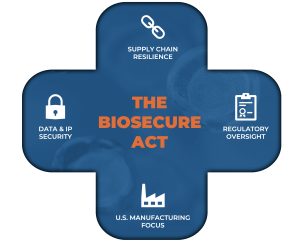
The BIOSECURE conversation began as a policy issue.
It is becoming something larger: a structural reset in how biotech companies evaluate manufacturing strategy, commercial readiness, and long-term supply risk.
For emerging and established biotech companies alike, the implications extend well beyond any single piece of legislation. The market is moving toward a new operating model — one in which biologics manufacturing is no longer treated as a downstream execution step, but as strategic infrastructure that directly supports enterprise value, regulatory confidence, and commercial continuity.
The future of biologics manufacturing will not be defined by geography alone.
It will be defined by resilient networks, inspection-proven capacity, disciplined execution, and the ability to support complex programs from clinical transition through commercial supply.
For companies approaching Phase 3, BLA submission, or commercial launch, that future is already here.
Beyond BIOSECURE: A Broader Manufacturing Realignment
The BIOSECURE Act has accelerated discussion around supply chain exposure, domestic manufacturing, and geopolitical risk. But the underlying forces reshaping the industry were already in motion.
Biologics portfolios are becoming more complex. Development timelines remain compressed. Capital markets continue to demand discipline. Regulators expect robust control strategies, validated processes, and reliable GMP execution. Boards are asking sharper questions about where and how critical supply is manufactured.
At the same time, companies are recognizing that manufacturing decisions made early in development can shape commercial flexibility years later.
A CDMO strategy that once appeared efficient may become limiting if it lacks:
- U.S.-based commercial supply options
- Demonstrated inspection experience
- Scalable GMP infrastructure
- Strong quality systems
- Tech transfer discipline
- Long-term capacity planning
This is the broader shift BIOSECURE has exposed: manufacturing risk is enterprise risk.
And enterprise risk cannot be solved reactively.

Lobby view of Rockville, Maryland GMP biologics manufacturing facility, part of Bora Biologics’ 20,000L installed U.S. manufacturing platform supporting late-stage and commercial biologics readiness.
The Rise of U.S. Biologics Manufacturing as Strategic Infrastructure
U.S. biologics manufacturing is no longer simply a domestic alternative. Increasingly, it is becoming a strategic pillar in commercial planning.
For biotech leaders, the value of a U.S.-based manufacturing pathway is not only proximity. It is optionality.
A credible U.S. pathway can support:
- Supply chain diversification
- Regulatory confidence
- Board and investor assurance
- Commercial launch continuity
- Reduced exposure to geopolitical disruption
- Faster executive oversight and decision-making
But not all U.S. capacity is equivalent.
The future will favor manufacturing platforms that combine domestic presence with commercial readiness — facilities capable of supporting GMP execution at scale, operating under mature quality systems, and managing the complexity of late-stage biologics programs.
Installed capacity matters.
But capacity alone is not resilience.
The true differentiator is whether that capacity is embedded within systems that can perform consistently under regulatory, commercial, and operational pressure.
What the Next Generation CDMO Model Requires
As biotech companies adapt to this new environment, CDMO selection criteria are changing.
The next generation of CDMO partnerships will be evaluated not only on technical capability or available slots, but on whether the partner can support a broader commercialization strategy.
That means the CDMO of the future must provide more than manufacturing services.
It must offer a platform for continuity.
1. Commercial-Scale Readiness
Companies approaching pivotal development need confidence that their manufacturing pathway can support commercial requirements without forcing late-stage redesign.
That includes sufficient GMP capacity, process scalability, validation planning, PPQ execution, and the ability to align development decisions with future supply needs.
Commercial readiness cannot begin after clinical success. It must be built into the program architecture before launch pressure arrives.
2. Inspection-Proven Quality Systems
As supply chains face greater scrutiny, inspection history and GMP maturity will become increasingly central to partner selection.
Facilities must not only manufacture product. They must withstand regulatory review, support filing confidence, and maintain disciplined execution across change control, deviation management, analytical methods, documentation, and validation.
For late-stage and commercial biologics programs, quality maturity is not a support function.
It is a value driver.
3. Geographic Optionality
The future is not purely domestic or purely global. It is hybrid.
Biotech companies will continue to rely on global expertise, specialized capabilities, and flexible development networks. But they will increasingly seek manufacturing architectures that reduce concentration risk and provide credible regional alternatives.
A resilient CDMO strategy will balance global efficiency with U.S.-based commercial readiness.
The strongest platforms will allow companies to preserve flexibility without compromising control.
4. Transfer Discipline
In a more volatile policy and regulatory environment, tech transfer capability becomes a strategic differentiator.
A manufacturing partner must be able to assess transfer feasibility, anticipate comparability requirements, support analytical bridging, and execute timelines without introducing unnecessary regulatory risk.
For companies moving toward BLA submission or commercial launch, transfer discipline can determine whether optionality is real — or only theoretical.
5. Selectivity and Platform Fit
As biologics pipelines grow more diverse, CDMOs will need to balance customization with reproducibility.
Not every facility is right for every program. Not every process fits every platform. And not every partner can scale complexity without creating operational fragmentation.
The CDMO of the future will be selective, disciplined, and transparent about fit.
That selectivity benefits sponsors. It protects execution quality, preserves operational focus, and improves the probability that programs can move from transfer to validation to commercial supply without preventable disruption.
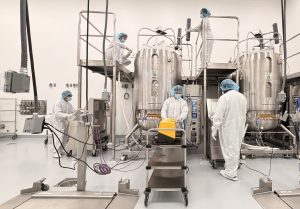
San Diego–based GMP biologics suites contributing to Bora Biologics’ 20,000L installed U.S. capacity, with expansion capability to reach 30,000L within the existing footprint.
The Future Is Hybrid, But Not Fragmented
The next era of biologics manufacturing will not be defined by retreating from global collaboration.
It will be defined by more intelligent network design.
Leading biotech companies will build manufacturing strategies that combine:
- Early development efficiency
- Commercial-scale planning
- U.S. manufacturing optionality
- Inspection-ready infrastructure
- Quality system maturity
- Supply continuity
- Practical transfer pathways
This is a hybrid model — but not a fragmented one.
Fragmented networks create complexity without control. Hybrid strategies create flexibility with discipline.
That distinction will matter more as companies approach commercialization. A global development path may remain efficient, but if the commercial pathway is not clearly defined, sponsors can face difficult decisions precisely when timelines, valuation, and regulatory expectations are most sensitive.
The future will reward companies that design manufacturing networks with the end state in mind.
Why Phase 3 Decisions Will Carry Greater Weight
Phase 3 has always been a critical clinical milestone.
It is increasingly becoming a manufacturing strategy milestone as well.
Before pivotal data, sponsors often retain meaningful flexibility to evaluate alternate supply pathways, assess transfer feasibility, and align commercial manufacturing strategy. After validation campaigns begin and regulatory filings take shape, that flexibility narrows quickly.
A late-stage manufacturing pivot can require:
- Additional engineering runs
- New PPQ campaigns
- Comparability studies
- Stability data
- Expanded regulatory documentation
- Launch timeline adjustments
These are not simply technical activities. They influence capital burn, revenue timing, investor confidence, and commercial preparedness.
In the future, boards will expect manufacturing strategy to be addressed before it becomes a constraint.
For biotech leaders, the question will not be, “Can we find capacity?”
It will be, “Can we demonstrate a credible, resilient, inspection-ready commercial pathway?”
Bora Biologics’ Perspective: Resilience Must Be Built, Not Claimed
At Bora Biologics, we believe the future of U.S. biologics manufacturing will be defined by execution credibility.
Resilience is not created by a press release, a policy position, or a capacity number alone. It is built through infrastructure, quality systems, technical discipline, and the ability to support clients through critical inflection points.
That is why Bora Biologics has continued to invest in U.S.-based GMP biologics manufacturing capacity and commercial readiness.
With a U.S. biologics manufacturing platform spanning Rockville, Maryland and San Diego, California, Bora Biologics offers 20,000L of installed U.S. capacity, with expansion capability to reach 30,000L within the existing footprint.
This platform is designed to support biotech companies seeking:
- U.S.-based commercial manufacturing optionality
- Late-stage and commercial biologics support
- Inspection-ready GMP infrastructure
- Practical tech transfer execution
- Long-term supply continuity
- A partner aligned with commercialization strategy
For companies navigating BIOSECURE-related uncertainty, the need is not simply to react to policy developments. It is to evaluate whether their manufacturing foundation is prepared for a more demanding future.
That future will require CDMO partners who can think beyond batches.
It will require partners who understand that manufacturing strategy is commercial strategy.
From Optionality to Advantage
The first phase of the BIOSECURE conversation focused on awareness.
The second phase focused on readiness.
The next phase will focus on advantage.
Companies that build resilient manufacturing strategies early will be better positioned to protect launch timelines, maintain regulatory confidence, support investor expectations, and respond to policy shifts without losing momentum.
Those that wait may find that available options are narrower, transfers are more complex, and commercial timelines are harder to protect.
In this environment, U.S. biologics manufacturing is not simply a safeguard.
It is a strategic advantage.
And the CDMO relationship is not simply a vendor decision.
It is a long-term commercialization decision.
Looking Ahead
The future of U.S. biologics manufacturing will be shaped by companies that understand the relationship between resilience and growth.
Policy may continue to evolve. Market expectations may shift. Global collaboration will remain important. But the direction is clear: biotech companies will need manufacturing strategies that are more transparent, more flexible, and more commercially durable.
For leadership teams preparing for Phase 3, BLA submission, or commercial launch, now is the time to ask:
- Is our commercial manufacturing pathway clearly defined?
- Do we have sufficient geographic optionality?
- Are our supply chain assumptions defensible to boards, investors, and regulators?
- Can our current CDMO strategy support long-term commercial continuity?
- If conditions change, do we have a practical path forward?
The companies that answer these questions early will be better positioned for the next era of biologics commercialization.
Because the future will not belong only to companies with promising science.
It will belong to companies that can reliably manufacture it, supply it, and bring it to patients without disruption.
BIOSECURE READINESS ASSESSMENT
Supply chain resilience is quickly becoming a board-level priority. If you are preparing for Phase 3, BLA submission, or commercial launch, now is the time to evaluate your manufacturing strategy.
Our BIOSECURE Readiness Assessment provides a focused review of:
- Supply chain exposure and geographic risk
- U.S. commercial manufacturing options
- Tech transfer feasibility and timing
- Commercial readiness considerations
- Potential constraints before they become urgent
Gain clarity before policy or market pressures force change.
Schedule a confidential BIOSECURE Readiness Assessment: