
The ROI of a CDMO Partnership: Why the Lowest Batch Price May Not Be the Lowest-Risk Choice
When selecting a CDMO partner, it is tempting to compare proposals through the most visible metric: batch price. On paper, the lowest cost per batch can appear to be the most financially disciplined choice.
But in biologics development and manufacturing, the lowest batch price is not always the lowest-cost path — and it is rarely the lowest-risk one.
For biotech and pharmaceutical companies working under aggressive timelines, limited funding windows, and high investor expectations, the true return on a CDMO partnership is measured not only in manufacturing cost, but in the partner’s ability to protect timelines, reduce technical uncertainty, support regulatory readiness, and help accelerate progression toward the next value-creating milestone.
Batch Price Is Only One Part of the Cost Equation
A batch quote captures a defined scope of work. It does not always capture the operational complexity required to move a program successfully from development to GMP manufacturing and beyond.
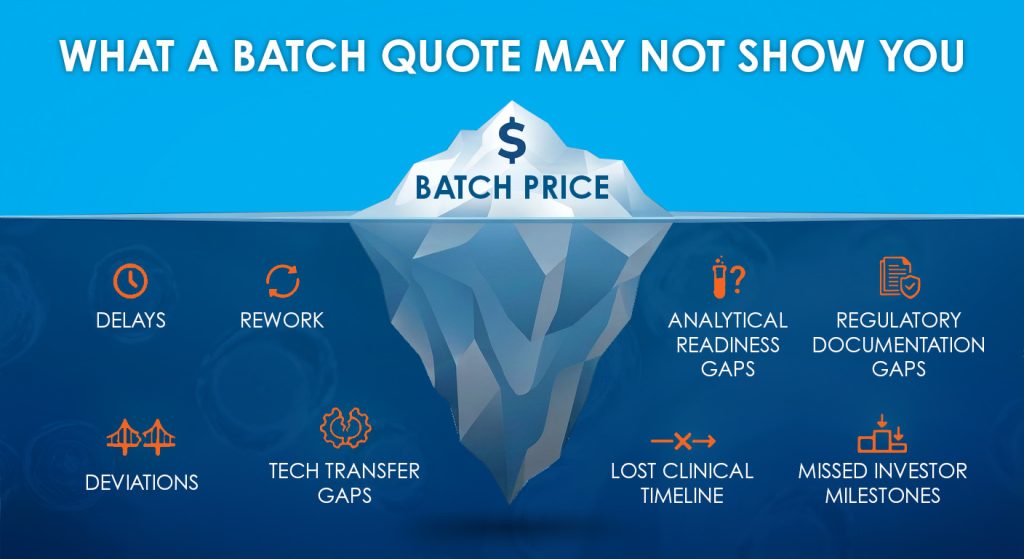
A lower batch price may come with hidden trade-offs, such as:
- Less experienced technical oversight
- Limited process development support
- Longer lead times for issue resolution
- Gaps between development and manufacturing teams
- Inflexible scheduling or facility access
- Insufficient analytical or quality support
- More limited regulatory documentation readiness
- Increased risk of batch failure, delay, or rework
These risks can quickly erase any upfront savings.
A delayed GMP batch, an avoidable deviation, an incomplete tech transfer, or a process that is not ready for scale can cost significantly more than the difference between two batch quotes. More importantly, it can delay IND submission, clinical supply availability, patient dosing, partnership discussions, or the next financing milestone.
In that context, the real question is not simply:
“What is the batch price?”
It is:
“What is the probability that this partner can get our program to the next milestone on time, with quality, and with fewer surprises?”
The True ROI of a CDMO Partnership
The return on a CDMO partnership comes from risk reduction.
A strong CDMO partner does more than execute a manufacturing run. The right partner helps sponsors make better decisions earlier, identify risks before they become delays, and design a development path that is technically sound, commercially practical, and regulatory ready.
That ROI may show up in several ways:
1. Faster Progression to Clinical Milestones
Speed matters, but only when it is paired with readiness. A CDMO with integrated development, manufacturing, analytical, and quality capabilities can help compress timelines by reducing handoffs, aligning technical teams early, and enabling faster transition from development work to GMP execution.
When development activities are designed with GMP manufacturing in mind, sponsors are better positioned to avoid late-stage surprises and move more confidently toward IND-enabling studies, clinical supply, and early-phase trials.
2. Lower Technical and Execution Risk
Complex biologics programs are rarely linear. Molecule expression, product quality, process robustness, scale-up behavior, analytical method readiness, and raw material strategy can all introduce risk.
An experienced CDMO partner brings pattern recognition across programs and modalities. That experience can help identify whether a challenge is a minor development issue, a potential manufacturability concern, or a risk that requires a strategic adjustment.
The value of that expertise is difficult to capture in a batch quote, but it can be decisive when timelines are tight.
3. Better Use of Sponsor Resources
Emerging and mid-sized biotech companies often operate with lean internal teams. In these cases, the CDMO becomes an extension of the sponsor’s technical, quality, regulatory, and operational infrastructure.
The right partner reduces the internal burden by providing clear project governance, proactive communication, disciplined documentation, and technical recommendations that help sponsor teams focus on strategic decisions rather than day-to-day troubleshooting.
The result is not just outsourced execution. It is operational leverage.
4. Reduced Risk of Rework
The cheapest path becomes expensive when work has to be repeated.
Rework can stem from many causes: incomplete process characterization, insufficient analytical readiness, poorly defined tech transfer packages, documentation gaps, or misalignment between development assumptions and manufacturing realities.
A strong CDMO partner helps reduce rework by building quality, manufacturability, and scalability into the program from the beginning.
That can mean the difference between a program that moves forward efficiently and one that loses months recovering from preventable issues.
5. Greater Confidence for Regulatory and Investor Milestones
Every development program is accountable to external stakeholders. Regulators, investors, boards, and strategic partners all expect evidence that the program is progressing in a controlled, credible, and well-documented way.
A CDMO that understands regulatory expectations and maintains strong quality systems can help ensure that manufacturing documentation, analytical data, deviations, change controls, and batch records are managed with the level of discipline needed to support clinical progression.
That confidence has real business value.
Lowest Cost vs. Lowest Risk
A low batch price may be appropriate for some programs, especially where the process is mature, the molecule is straightforward, the timeline is flexible, and the sponsor has strong internal technical oversight.
But for many biologics programs — especially early clinical programs, complex molecules, accelerated development timelines, or sponsors with lean teams — the lowest quoted price may create unacceptable exposure.
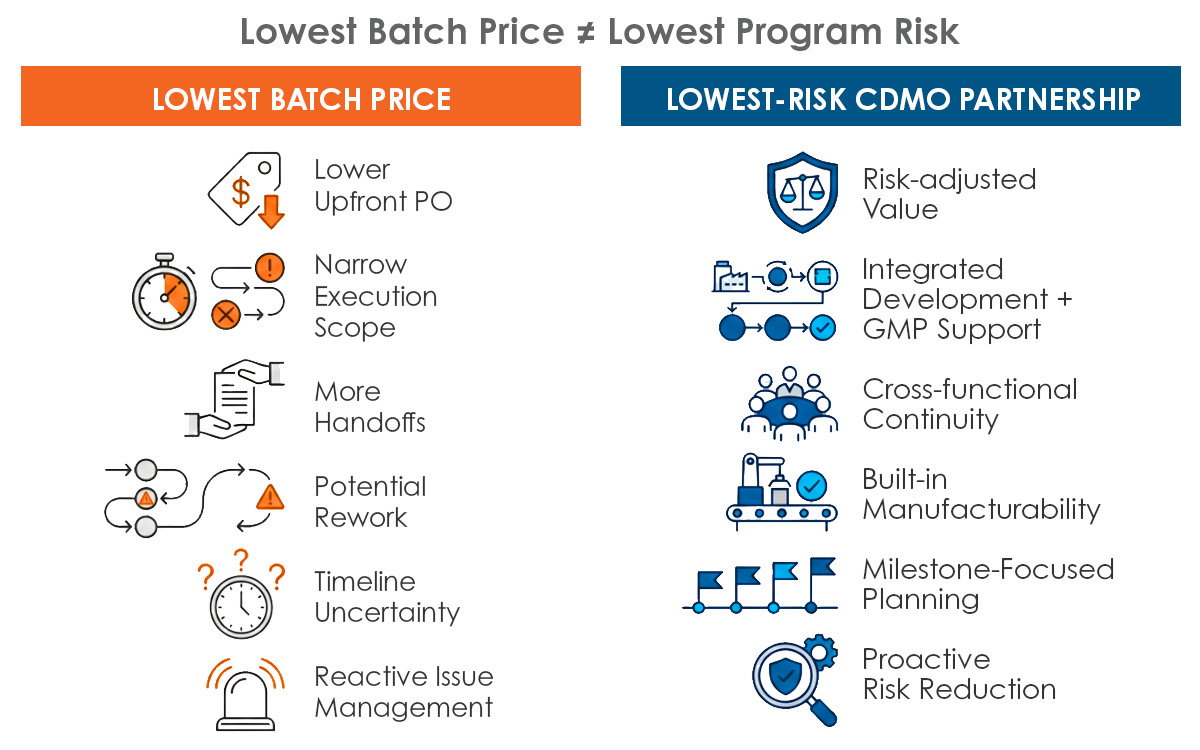
The better measure is risk-adjusted value.
A CDMO partnership should be evaluated based on the total value it brings to the program, including:
- Technical depth
- Development-to-GMP continuity
- Manufacturing reliability
- Analytical and quality capabilities
- Regulatory documentation support
- Project management discipline
- Facility fit and scheduling confidence
- Communication transparency
- Ability to anticipate and resolve issues
- Alignment with the sponsor’s clinical and commercial goals
This broader view helps sponsors distinguish between a vendor that can perform a task and a partner that can protect the program.
What Sponsors Should Ask Before Choosing a CDMO
Before selecting a CDMO based primarily on batch price, sponsors should ask:
- How will this partner reduce execution risk?
- What technical assumptions are built into the quote?
- What happens if the process does not behave as expected?
- How integrated are development, analytical, manufacturing, and quality teams?
- What is the partner’s track record with similar molecules or program stages?
- How will they support documentation and regulatory readiness?
- How transparent is communication when challenges arise?
- Will this partner help us reach our next milestone faster — or simply offer a lower batch price?
- The answers to these questions often reveal the true cost of the partnership.
Bora Biologics’ Perspective: Partnership Designed Around Progression
At Bora Biologics, we believe CDMO value is measured by the ability to help sponsors advance with confidence. Our approach is built around supporting programs from early development through clinical and commercial manufacturing with the technical insight, operational discipline, and quality focus needed to reduce risk at each stage.
For biologics sponsors, that means aligning cell line development, process development, analytical strategy, GMP manufacturing, and drug product planning around the program’s next critical milestone. For pharmaceutical partners, it means combining manufacturing expertise, regulatory experience, and flexible capacity to support reliable supply and long-term value.
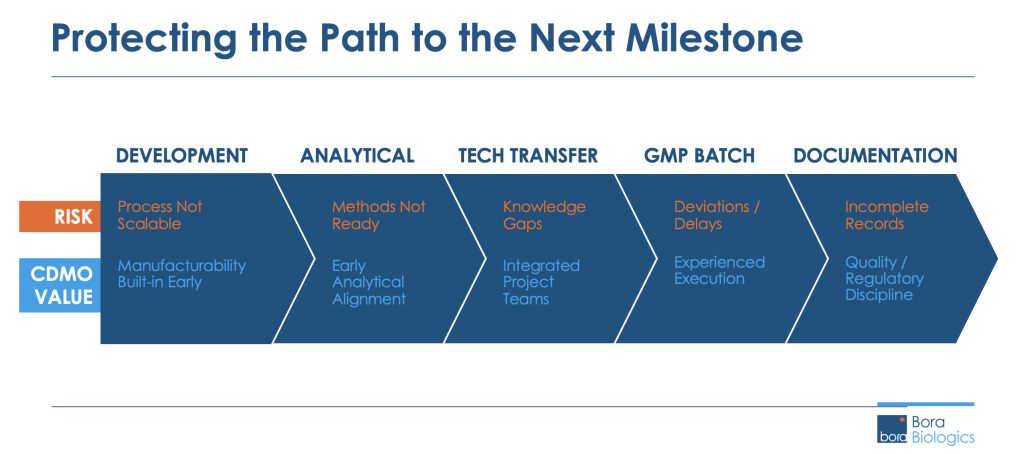
The goal is not simply to deliver a batch.
The goal is to help protect the path forward.
The Bottom Line
The lowest batch price may reduce the purchase order.
But the right CDMO partnership can reduce the risk to the program.
In a development environment where time, quality, and investor confidence are closely linked, the highest-ROI CDMO partner is often the one that helps sponsors avoid delays, reduce rework, preserve optionality, and reach value-creating milestones with greater confidence.
When choosing a CDMO, sponsors should look beyond the batch quote and ask a more strategic question:
Which partner gives our program the best chance of success?