
Tech Transfer Without Disruption: What Biologics Sponsors Need Before Moving a Program
 Biologics sponsors are rethinking where and how their programs are manufactured. For many companies, this shift is being driven by supply-chain resilience, geopolitical uncertainty, capacity access, and BIOSECURE-related concerns. The result is a growing need to move programs from one CDMO or manufacturing site to another — often under significant timeline pressure.
But biologics tech transfer is rarely simple.
Moving a biologics program is not the same as transferring a small-molecule process or sending a documentation package to a new vendor. Biologics manufacturing depends on living systems, complex process parameters, sensitive analytical methods, and product-quality attributes that may shift when a process is introduced into a new facility, new equipment train, or new operating environment.
A poorly planned transfer can create exactly the disruption the sponsor is trying to avoid: delayed campaigns, failed engineering runs, unexpected product-quality changes, additional comparability work, and regulatory uncertainty.
Successful tech transfers start before material moves.
Sponsors need a receiving CDMO that can rapidly understand the molecule, identify the highest-risk gaps, reproduce process and analytical performance, and maintain development momentum without compromising product quality or regulatory continuity.
 Why Tech Transfer Risk Is Rising
A batch quote captures a defined scope of work. It does not always capture the operational complexity required to move a program successfully from development to GMP manufacturing and beyond.
Historically, many biologics tech transfers were driven by normal development progression: moving from process development to GMP manufacturing, scaling from clinical to commercial production, or transferring methods from R&D to QC.
Today, another driver has become more urgent: network risk.
Sponsors may be evaluating alternative CDMOs or backup manufacturing sites because of:
- Supply-chain concentration risk
- Geopolitical exposure
- CDMO capacity constraints
- Regulatory or inspection concerns
- Business continuity planning
- Need for regional manufacturing options
- BIOSECURE-related sourcing and partner decisions
For many sponsors, especially emerging biotechs, the question is no longer whether they should consider a backup or alternative manufacturing path. The question is how to move quickly without destabilizing the program.
This is where biologics tech transfer becomes a strategic CMC risk-management exercise.
Tech Transfer Is Not a Document Handoff
One of the most common mistakes sponsors make is treating tech transfer as an administrative activity. The sending site provides batch records, analytical methods, process descriptions, raw material lists, development reports, and historical data. The receiving site reviews the package and prepares to execute.
That documentation is essential — but it is not sufficient.
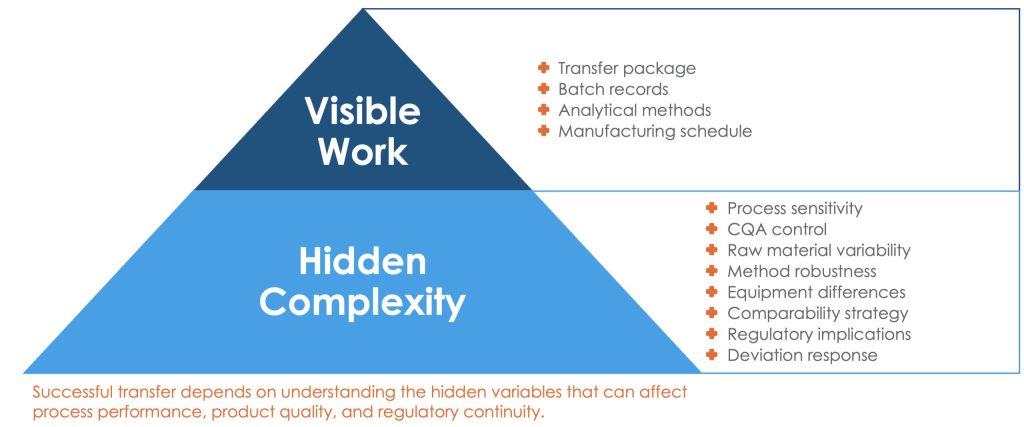
In biologics, much of the real process knowledge sits between the lines:
- Which parameters are truly critical versus historically convenient
- Which unit operations are sensitive to small changes in equipment or scale
- Which impurities are process-driven versus molecule-inherent
- Which analytical methods are robust and which only work under narrow conditions
- Which raw materials have meaningful lot-to-lot impact
- Which deviations occurred during development but were never fully captured as risk
- Which product-quality attributes are most likely to shift after transfer
A successful receiving CDMO does not simply ask, “Can we run this process?” It asks, “Where can this process fail when translated into our facility, and how do we prevent that failure before GMP execution?”
The Main Failure Points in Biologics Tech Transfer
When a biologics transfer goes off track, the cause is usually not a single catastrophic mistake. More often, disruption comes from a series of underestimated differences between the original process and the receiving environment.
1. Process Performance Does Not Reproduce
The transferred process may perform differently at the receiving site. Sponsors may see changes in titer, yield, impurity clearance, aggregation, charge variants, glycosylation, or overall recovery.
These changes can be caused by differences in:
- Bioreactor geometry or mixing
- Scale and oxygen-transfer characteristics
- Media preparation and hold conditions
- Chromatography resin history or column packing
- Filtration systems
- Buffer preparation
- Process timing
- Operator practices
- Raw material sourcing
Even when the process description appears complete, small differences can create measurable product-quality or process-performance shifts.
2. Analytical Methods Are Not Transfer-Ready
Analytical transfer is often one of the biggest sources of delay. A method that worked at the originating site may not be robust enough for a new QC environment.
Common issues include:
- Incomplete method parameters
- Ambiguous sample preparation instructions
- Lack of system suitability criteria
- Instrument platform differences
- Reagent or reference standard availability
- Assay variability
- Limited sensitivity for low-concentration or complex samples
- Methods that were useful in development but not suitable for release or comparability
Without strong analytical readiness, the receiving site cannot confidently determine whether the process has transferred successfully.
3. Comparability Is Considered Too Late
Comparability should not be an afterthought. It should be designed before transfer execution begins.
Sponsors need to define how they will demonstrate that product quality remains comparable before and after the move. That means identifying:
- Which pre-transfer lots will serve as comparators
- Which post-transfer lots will be included
- Which CQAs will be evaluated
- Which orthogonal analytical methods are needed
- What acceptance criteria or scientific justifications will be used
- How differences will be interpreted
- What additional characterization may be required if a shift is observed
If comparability planning begins only after the first transferred batch is produced, the sponsor may discover too late that the right samples, methods, or reference data are not available.
4. Facility and Equipment Differences Are Underestimated
No two CDMO sites are identical. Even when the same process is followed, differences in facility design, utilities, equipment, automation, consumables, and scale can affect execution.
Before transfer, sponsors and receiving CDMOs should compare:
- Bioreactor type and working volume
- Mixing and mass-transfer characteristics
- Single-use versus stainless-steel systems
- Chromatography skid configuration
- Column dimensions and resin availability
- Filtration surface area and membrane type
- Hold vessels and container closure systems
- Freeze-thaw capability
- Cleaning or single-use strategy
- Facility layout and operation workflow
- Environmental monitoring and contamination-control approach
A detailed gap assessment helps determine whether the process can be transferred as-is or requires adaptation.
5. Governance Not Fully Defined
Tech transfer involves many teams: sponsor CMC, sending site, receiving site, analytical development, QC, QA, regulatory, supply chain, procurement, manufacturing, MSAT, and project management.
Without clear governance, decisions stall.
Common problems include:
- Unclear ownership of process changes
- Slow resolution of documentation gaps
- No predefined escalation path for technical issues
- Delayed quality approvals
- Misalignment between sponsor, sending site, and receiving site
- Inconsistent assumptions about timeline, scope, or success criteria
A strong transfer plan should define who decides, who approves, who executes, and how quickly issues must be resolved.
What Sponsors Need Before Moving a Program
Before committing to a CDMO switch, sponsors should pressure-test six areas.
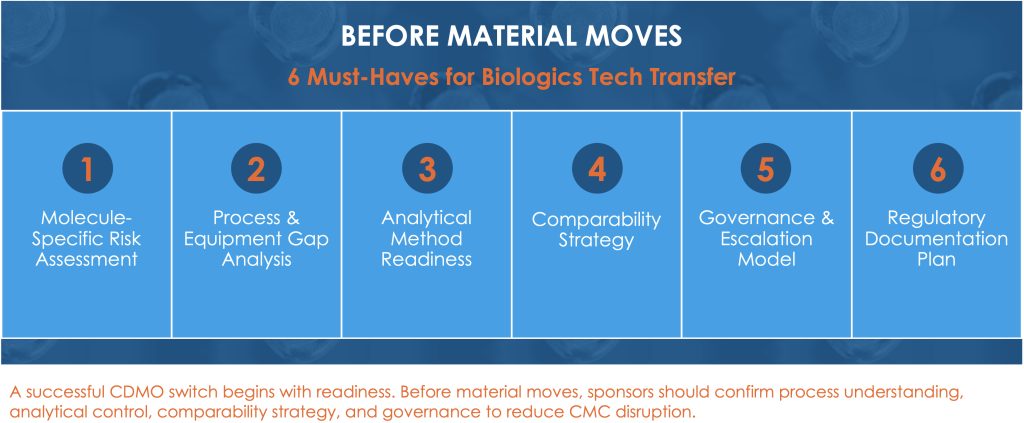
1. A Molecule-Specific Transfer Risk Assessment
Every biologic has its own risk profile. A monoclonal antibody, bispecific antibody, fusion protein, ADC, or antibody-oligonucleotide conjugate will each present different transfer challenges.
A strong risk assessment should cover:
- Molecule format and structural complexity
- Confirmed or presumptive CQAs
- Cell line and upstream process sensitivity
- Downstream impurity-clearance strategy
- Product-related impurities
- Charge, size, and glycosylation heterogeneity
- Analytical method maturity
- Raw material dependencies and variability
- Formulation and stability profile
- Manufacturing history and prior deviations
- Regulatory commitments or filing constraints
The goal is to identify the areas most likely to create disruption and address them before execution.
2. A Clear Comparability Strategy
The transfer plan should define how product quality continuity will be demonstrated.
This may include:
- Side-by-side testing of pre- and post-transfer lots
- Orthogonal analytical characterization
- Stability comparison
- Impurity-profile assessment
- Potency or binding assays
- Higher-order structure assessment where appropriate
- Glycan or charge-variant profiling
- Statistical or scientifically justified acceptance criteria
For early-stage programs, comparability may be more flexible and development-focused. For late-stage or commercial programs, the strategy must be more rigorous and regulatory-aligned.
The key is to define expectations early.
3. Analytical Readiness
A process cannot be transferred successfully if the analytical package cannot reliably measure product quality.
Sponsors should ask:
- Are the methods qualified or validated for their intended use?
- Are they robust enough for transfer to a new lab?
- Are critical reagents, standards, and controls available?
- Are system suitability criteria defined?
- Are sample preparation steps clear and reproducible?
- Are methods sensitive enough for expected samples?
- Are orthogonal methods available for key CQAs?
- Can the receiving QC lab execute the methods within the required timeline?
Analytical readiness is one of the most important safeguards against transfer-related uncertainty.
4. Process and Equipment Gap Analysis
The receiving CDMO should perform a structured comparison between the original process and its own manufacturing environment.
This includes:
- Unit operation mapping
- Scale comparison
- Equipment fit assessment
- Raw material and consumable availability
- Process parameter translation
- Automation and control-system differences
- Hold-time and storage-condition evaluation
- Sampling plan alignment
- Cleaning, contamination-control, or single-use strategy
- Facility scheduling and campaign readiness
A gap analysis should not be a checklist exercise. It should result in clear decisions: transfer as-is, adapt with justification, or perform additional development before GMP production.
5. Defined Governance and Escalation
Sponsors should establish a transfer governance model before execution begins.
This should include:
- Transfer team structure
- Key milestones defined
- Workstream owners
- Decision rights
- Quality and regulatory approval pathways
- Deviation and change-control process
- Meeting cadence
- Risk log and issue tracker
- Escalation timelines
- Documentation responsibilities
- Criteria for engineering run and GMP readiness
The faster issues are surfaced and resolved, the lower the risk of timeline disruption.
6. Regulatory-Aligned Documentation
Tech transfer decisions can affect regulatory filings, agency interactions, and inspection readiness.
Documentation should support:
- Rationale for the transfer
- Description of site, equipment, process, and analytical changes
- Comparability strategy and results
- Change-control decisions
- Risk assessments
- Process performance summary
- Analytical method transfer package
- Deviations and investigations
- Stability strategy
- GMP readiness and batch execution history
Even when a transfer occurs early in development, disciplined documentation helps avoid problems later.
Bora Biologics’ Perspective: Disruption-Free Tech Transfer
At Bora Biologics, tech transfer is treated as an integrated CMC execution process — not just a project-management milestone.
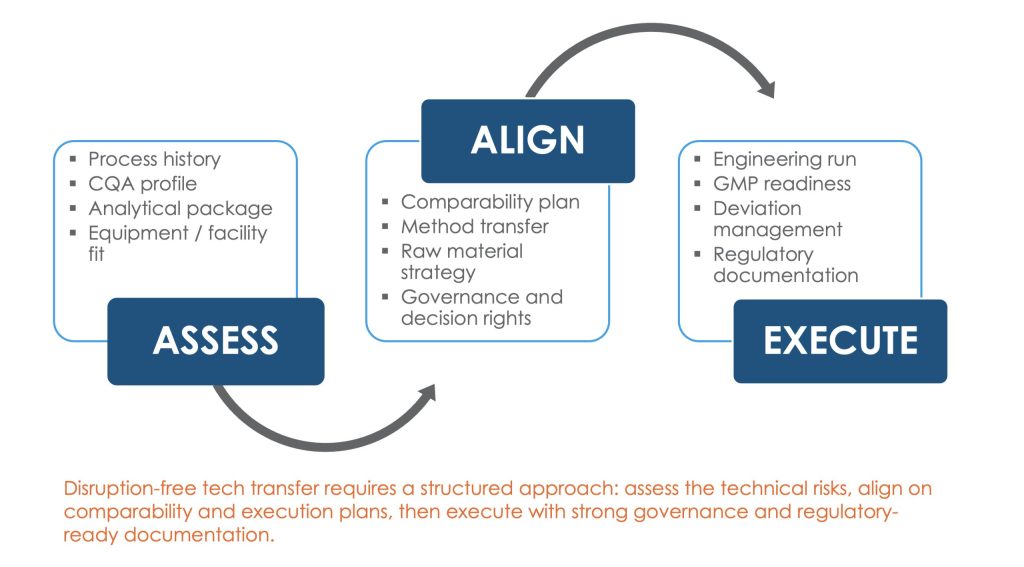
Our approach focuses on three priorities:
1. Understand the Molecule Before Running the Process
Bora begins by assessing the molecule, the process history, the analytical package, and the known development risks. This allows the team to determine where the process is likely to be sensitive and where additional controls or adaptations may be needed.
For complex biologics, this is especially important. Product quality may be influenced by subtle differences in cell culture, purification, formulation, or analytical execution.
2. Build the Transfer Around Process and Analytical Control
A transfer is only as strong as the ability to measure success. Bora emphasizes analytical readiness, method transfer, and comparability planning early in the project.
This includes reviewing whether existing methods are fit for purpose, identifying method gaps, and ensuring that critical quality attributes can be monitored before engineering or GMP runs begin.
3. Maintain Momentum Through Structured Execution
Tech transfer often occurs under pressure. Sponsors may need a new manufacturing path quickly, but speed cannot come at the expense of control.
Bora supports rapid execution through structured workstreams, defined responsibilities, risk-based planning, and integrated communication across PD, MSAT, analytical, QC, QA, manufacturing, supply chain, and regulatory-support functions.
The objective is simple: move the program without losing time, quality, or control.
Questions Sponsors Should Ask a Receiving CDMO
Before moving a biologics program, sponsors should ask potential receiving CDMOs:
- How will you assess transfer risk before execution begins?
- What process and equipment gaps do you expect based on our current process?
- How will you determine whether the transferred process is comparable?
- Can your QC lab execute our analytical methods, or will methods need to be adapted?
- What additional characterization do you recommend before GMP manufacturing?
- How do you manage deviations, change control, and technical issue escalation during transfer?
- What is your experience with complex biologics such as bispecifics, fusion proteins, ADCs, or conjugates?
- How will you support regulatory documentation related to the site or process transfer?
- What are the likely timeline risks, and how will they be mitigated?
- What information do you need from the sponsor and sending site before kickoff?
The answers to these questions reveal whether the CDMO is simply accepting the transfer or actively de-risking it.
The Cost of Moving Too Fast Without Control
In supply-risk-driven transfers, speed is often the priority. But moving too quickly without sufficient technical planning can create significant downstream costs.
A rushed transfer can result in:
- Failed or repeated engineering runs
- GMP batch delays
- Unexpected impurity or CQA shifts
- Additional analytical troubleshooting
- Incomplete comparability packages
- Regulatory questions
- Stability or formulation gaps
- Increased cost of goods
- Delayed clinical or commercial supply
A disciplined transfer plan may require more upfront work, but it reduces the risk of expensive disruption later.
 Expert Insight
Tech transfer is not successful when the process is merely reproduced at a new site. It is successful when product quality, process control, regulatory continuity, and program momentum are preserved after the move.
For biologics sponsors navigating BIOSECURE-driven or supply-risk-driven CDMO switching, the best tech transfer practice starts before materials move. It starts with process understanding, analytical readiness, comparability planning, and a receiving CDMO that can anticipate where disruption is most likely to occur.
In today’s environment, tech transfer is not just an operational handoff.
It is a strategic CMC risk-management exercise.