Phase 3 is a Manufacturing Strategy Milestone — Not Just a Clinical Milestone
 For many biologics companies, Phase 3 is viewed primarily as a clinical milestone — the stage where pivotal efficacy and safety data begin to define the path toward approval.
But for late-stage biologics programs, Phase 3 is also something else:
A critical manufacturing strategy milestone.
By the time a program enters pivotal development, the decisions made around manufacturing network design, tech transfer, process control, quality readiness, supply continuity, and commercial scalability can shape not only the path to BLA submission — but the confidence with which a company can launch, supply, and sustain the product after approval.
For biotech leaders, the question is no longer simply:
Can we complete Phase 3?
It is also:
Can our manufacturing strategy support what comes after Phase 3?
Phase 3 Is When Manufacturing Flexibility Starts to Narrow
Earlier in development, companies often have more flexibility to adjust manufacturing strategy. Processes can be refined. Alternate partners can be evaluated. Analytical methods can evolve. Supply pathways can be reassessed.
But as a biologics program moves into Phase 3, that flexibility begins to narrow.
Pivotal development brings greater expectations around process consistency, documentation discipline, comparability, quality maturity, and regulatory alignment. The manufacturing decisions made during this period can influence validation planning, PPQ readiness, filing strategy, inspection preparedness, and commercial supply execution.
Late changes can still be possible, but they may carry significant consequences, including:
- Additional engineering or demonstration runs
- Comparability requirements
- Stability considerations
- Analytical bridging work
- PPQ delays
- Expanded regulatory documentation
- Increased launch timeline risk
- Higher program cost and operational complexity
That is why Phase 3 should not be treated only as a clinical execution stage.
It should be treated as the point where manufacturing strategy becomes inseparable from commercial strategy.
The Hidden Risk: Treating Manufacturing as a Post-Data Decision
A common mistake in late-stage development is waiting for pivotal readouts before making deeper manufacturing decisions.
On the surface, this can seem efficient. Companies may want to conserve capital, avoid premature commitments, or wait until clinical risk is reduced.
But waiting too long can create a different kind of risk.
If manufacturing strategy is deferred until after Phase 3 data, the program may have less time to address process transferability, scale-up assumptions, supply chain exposure, quality system readiness, inspection expectations, and commercial demand planning.
For biologics, these are not last-minute decisions. They require technical depth, documentation discipline, cross-functional alignment, and operational lead time.
The better question is not whether every commercial decision must be finalized before pivotal data.
It is whether the program has a credible, flexible, inspection-ready manufacturing path that can support success if the data are positive.
What Biotech Leaders Should Reassess Before or During Phase 3
For companies approaching Phase 3, entering pivotal studies, or preparing for BLA planning, manufacturing strategy should be reviewed through a commercial-readiness lens.
Key areas to evaluate include:
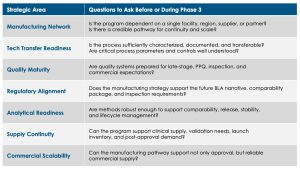
The goal is not simply to identify risks.
The goal is to understand whether the current manufacturing path can withstand the pressure of late-stage development and commercial transition.
BIOSECURE Readiness Adds Another Layer of Urgency
The broader supply chain environment is also changing.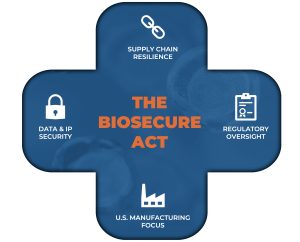
The industry conversation around BIOSECURE readiness has reinforced a larger point: biologics companies, investors, boards, and partners are paying closer attention to where and how critical manufacturing activities are performed.
Regardless of how policy evolves, the operational signal is clear. Companies are being asked to think more carefully about geographic exposure, supply continuity, tech transfer feasibility, and manufacturing resilience.
For late-stage programs, this creates an important strategic consideration:
If your current manufacturing pathway became constrained, could your program adapt without compromising timeline, quality, or regulatory confidence?
That question is especially important in Phase 3, when the cost of change is higher and the available time to execute alternatives is shorter.
BIOSECURE readiness should not be treated only as a policy response. For biologics companies nearing commercial transition, it should be considered part of manufacturing strategy, enterprise risk management, and launch preparedness.
Commercial Readiness Is Built Before Approval
Commercial readiness does not begin after approval.
It is built through earlier decisions that determine whether a program can move from pivotal development to validation, filing, inspection, launch, and sustained supply without unnecessary disruption.
That includes decisions around:
- Facility fit and capacity planning
- Process characterization and control strategy
- Analytical method readiness
- Raw material and supplier strategy
- Drug substance and drug product coordination
- Tech transfer planning
- PPQ and validation readiness
- Quality system maturity
- Inspection preparation
- Supply chain resilience
Each of these decisions affects the company’s ability to move with confidence after Phase 3 success.
For biologics companies, the most expensive manufacturing risk may not be lack of capacity.
It may be discovering too late that the current path is not commercially durable.
Why Bora Biologics
At Bora Biologics, we help customers think beyond the next batch and plan for the next stage of growth.
Our teams support biologics companies across critical development and manufacturing transitions, with capabilities spanning mammalian and microbial expertise, GMP biologics manufacturing, technical transfer, process development, quality systems, and clinical-to-commercial supply planning.
For late-stage programs, our focus is on helping customers reduce uncertainty and build a manufacturing pathway that is practical, resilient, and aligned with future regulatory and commercial expectations.
That means supporting sponsors with:
- Development and GMP manufacturing expertise
- Mammalian and microbial capabilities
- U.S.-based GMP biologics manufacturing
- Experienced technical and quality teams
- Tech transfer and scale-up support
- Clinical and commercial supply readiness
- A client-centered partnership model
Because in Phase 3, manufacturing strategy is no longer a back-office operational decision.
It is a commercial readiness decision.
The Strategic Question for Phase 3 Teams
If your biologics program is approaching or entering Phase 3, now is the time to ask:
Is our manufacturing strategy ready for the clinical success we are working toward?
A strong Phase 3 strategy should do more than support pivotal trials. It should prepare the program for validation, filing, inspection, launch, and sustained supply.
Phase 3 is not just the stage where clinical value is proven.
It is the stage where commercial manufacturing confidence must be built.
Planning for Phase 3, BLA submission, commercial launch, or a critical manufacturing decision?
Connect with Bora Biologics to discuss how a resilient, inspection-ready manufacturing strategy can support your program’s next milestone.