Next-Generation Cell Line Development: Earlier Learning, Informed Decisions
Explore how Bora Biologics’ second-generation cell line development platform could support earlier learning—and a more informed development path.
For biologics sponsors, acceleration is not simply about shortening a timeline. It is about generating useful evidence sooner while maintaining a clear understanding of quality, risk, and the work still ahead.
Stable cell pools may offer an opportunity to begin selected development activities while individual clones are being evaluated. Their value depends on an important question: is the pool-derived material sufficiently representative of the eventual clone-derived product for its intended use?
At Bora Biologics, we are investigating that question through our second-generation cell line development platform, which uses site-specific integration.
 A Closer Look at Next-Generation CLD
Site-specific integration provides greater control over where genetic material is introduced during cell line development. This offers a scientific rationale for investigating consistency between stable pools and individual clones.
In the data reviewed to date, Bora Biologics’ technical team has observed highly similar measured quality attributes between pool-derived material and material from individual clones using our second-generation platform.
These findings are promising. Their practical significance depends on the molecule, the attributes evaluated, the production conditions, and the development activity the material is intended to support.
Earlier material is valuable when it helps answer the right question—not simply because it is available sooner.
What Could Earlier Learning Mean for Your Program?
Bora Biologics’ CLD workflow includes early sample generation to support process, formulation, and analytical development while clone evaluation continues:
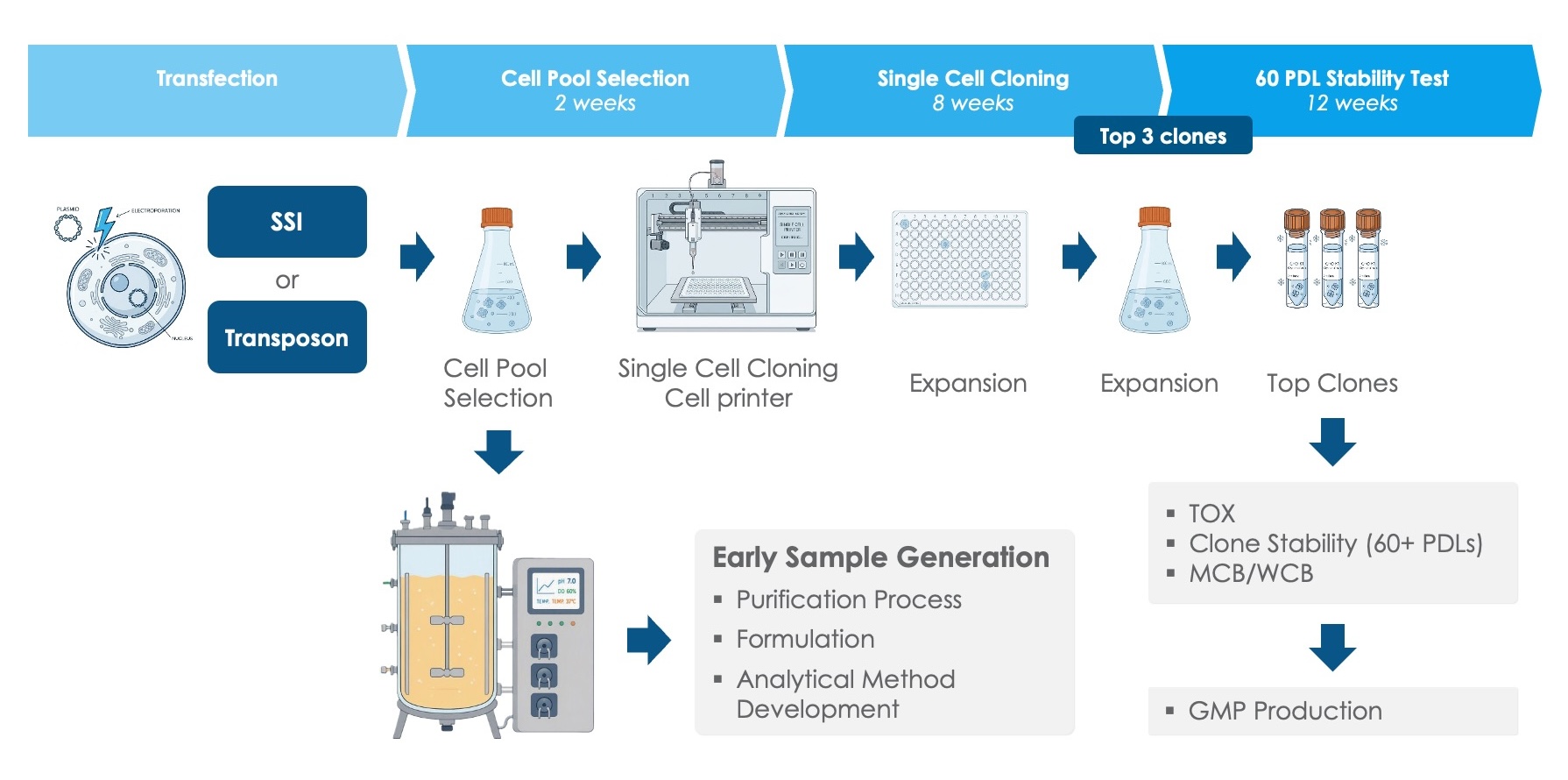
A scientifically grounded strategy considers both the immediate opportunity and the downstream implications.
- Speed Through Connected Execution
Could selected development activities begin while clone evaluation continues? Aligning cell line development, process development, and analytics helps identify where earlier material could support meaningful parallel work. - Quality and Risk Mitigation
What evidence would establish suitability for the intended activity? Understanding the measured attributes, remaining uncertainties, and confirmation requirements helps define responsible decision gates. - Cost-Effectiveness Across the Development Path
Could earlier evidence inform a decision before additional resources are committed? The assessment should include characterization, subsequent confirmation, and potential repeat work—not just initial time savings. - Flexibility Grounded in Expertise
Is a stable-pool approach appropriate for your molecule and milestone? The answer requires a program-specific assessment, rather than a standard recommendation for every sponsor.
Review the Science with Our Team
We invite sponsors to meet with Bora Biologics’ CLD and development experts to review our second-generation CLD findings and discuss their potential relevance to a specific development program.
 The conversation can explore:
- What our pool-to-clone observations show—and their current limitations.
- Which development questions earlier material could help address.
- What would still need to be confirmed using the selected clone.
- How an approach could affect timelines, resource requirements, and downstream risk.
- Where coordinated development activities could support the next milestone.
Our approach brings scientific expertise, quality, flexibility, connected execution, and partnership together to evaluate opportunities for responsible speed, risk mitigation, and cost-effectiveness.
Accelerate the Milestone. Understand the Trade-Offs.
The strongest acceleration strategy is not necessarily the one that starts fastest. It is the one that generates useful evidence sooner while maintaining a credible path to the next stage.
Meet with Bora Biologics’ technical team to review our second-generation CLD findings and discuss the potential opportunities, evidence requirements, and trade-offs for your program.