
BIOSECURE Readiness in Practice: Operationalizing Supply Chain Resilience Before Commercial Launch
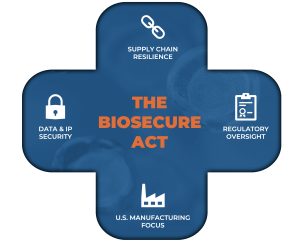
The BIOSECURE Act has prompted important discussion across the life sciences industry. While legislative details continue to evolve, the broader signal is already clear: biotechnology supply chains are moving under heightened scrutiny, where national security considerations, regulatory expectations, and commercial risk increasingly intersect.
For biotech companies, particularly those approaching Phase 3 or commercial launch, the relevant question is no longer whether policy may shift. It is whether their manufacturing strategy is structurally prepared.
Awareness of policy trends is valuable.
Operational readiness is decisive.
From Policy Signal to Operational Condition
Over the past decade, biotech development models prioritized speed, capital efficiency, and technical capability. Globalized supply chains enabled companies to optimize cost and accelerate timelines by distributing development, manufacturing, and commercialization activities across regions.
That model is now being reevaluated.
Regulators, investors, and boards are placing greater emphasis on supply continuity, geographic exposure, inspection history, and domestic manufacturing pathways. Regardless of the ultimate scope of legislation, resilience is becoming a structural expectation rather than a contingency plan.
In this environment, “BIOSECURE readiness” is not a communications posture. It is an operational condition.
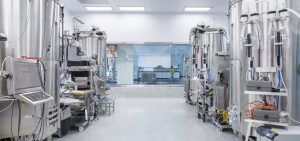
Rockville, Maryland GMP biologics manufacturing facility with 11,000L installed commercial capacity, contributing to Bora Biologics’ 20,000L total U.S. manufacturing platform.
What Readiness Actually Requires
True supply chain resilience is built long before a regulatory filing. It is embedded in infrastructure decisions, development strategy, and partner selection.
For leadership teams, readiness can be assessed across four practical dimensions:
1. Commercial Pathway Clarity
Is there a credible, inspection-ready commercial manufacturing pathway aligned with projected demand?
Are facilities capable of scaling without late-stage process redesign?
Is commercial capacity integrated into development planning — or deferred until after pivotal trials?
Companies that address these questions early avoid compressed decision-making under regulatory timelines.
Readiness, however, is not defined by installed capacity alone. It is determined by the strength of the underlying systems — quality oversight, change control discipline, analytical robustness, and tech transfer execution — that allow infrastructure to perform consistently under portfolio and fragmentation pressure.
2. Geographic Optionality
How exposed is the supply chain to regional disruption or policy change?
Is there a viable U.S.-based commercial route, if required?
Has geographic diversification been designed intentionally, or accumulated incidentally?
Optionality is not created overnight. It must be engineered into the platform before it becomes urgent.
3. Regulatory and Inspection Confidence
Inspection history, GMP maturity, and validation readiness are increasingly central to risk assessment. For products approaching BLA submission, manufacturing environments must support not only technical capability but regulatory confidence.
Inspection-proven facilities and commercial GMP experience reduce uncertainty at precisely the stage when uncertainty becomes most expensive.
4. Transfer Feasibility and Timeline Risk
If policy conditions shift, how feasible is a tech transfer in practical terms?
What would be required to demonstrate comparability?
How would additional PPQ campaigns, stability studies, or regulatory bridging affect launch timelines?
These are not theoretical considerations. They represent real cost, time, and valuation implications.
The Phase 3 Inflection Point
For many biotech companies, Phase 3 represents the last meaningful window of flexibility.
Prior to pivotal data, manufacturing decisions retain a degree of optionality. After validation campaigns begin and regulatory filings approach, that flexibility narrows rapidly. Process comparability requirements tighten. Stability timelines extend. Regulatory expectations solidify.
Late-stage manufacturing pivots introduce material complexity:
- Additional engineering runs
- New validation campaigns
- Bridging studies
- Expanded regulatory documentation
- Delayed launch timelines
Each carries financial consequences — from increased capital burn to delayed revenue realization.
Boards are increasingly aware that supply chain decisions made before Phase 3 can materially influence commercial risk.
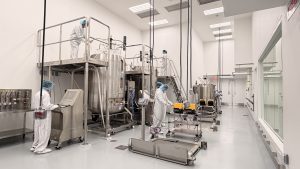
San Diego–based GMP biologics suites contributing to Bora Biologics’ 20,000L installed U.S. capacity, with expansion capability to reach 30,000L within the existing footprint.
The Emerging Hybrid Model
The industry is not retreating from global collaboration. Rather, it is evolving toward more balanced architectures.
Leading biotech companies are adopting hybrid models that combine:
- Development efficiency and technical expertise
- Geographic diversification
- U.S.-based commercial readiness
- Inspection-proven GMP infrastructure
- Long-term supply continuity planning
This approach does not reject global integration. It strengthens it by allowing companies to balance flexibility and control.
Increasingly, this also requires selectivity in program intake and alignment to platform fit, ensuring that customization does not erode the reproducibility that commercial supply depends on.
Resilience, in this sense, becomes a design principle rather than a reaction.
Proactive Versus Reactive Strategy
There is a meaningful distinction between preparing for structural change and responding to it under pressure:
- Reactive strategy often involves compressed timelines, constrained partner selection, and elevated execution risk.
- Proactive strategy involves early evaluation of supply chain exposure, feasibility modeling, and integration of commercial-scale considerations during development.
The difference is not simply operational. It is strategic. Organizations that evaluate optionality before urgency maintain negotiating leverage, regulatory confidence, and commercial momentum.
Those that wait may find that flexibility has already narrowed.
Manufacturing as Strategic Infrastructure
The BIOSECURE conversation is ultimately part of a broader shift in how manufacturing is perceived. It is no longer a downstream function activated after clinical success. It is strategic infrastructure that underpins valuation, regulatory confidence, and market access.
In a biologics-driven market, where complexity and capital intensity are increasing, manufacturing strategy must align with enterprise strategy from the outset. Legislation may continue to evolve. Geopolitical conditions may shift. Regulatory expectations may adapt.
But one principle is stable: Supply chain resilience built early is far less disruptive than resilience built under pressure.
For biotech leaders navigating Phase 3 and commercial transition, readiness is not about predicting policy outcomes. It is about embedding structural flexibility into the foundation of commercialization — long before launch.
For organizations seeking greater clarity, a structured evaluation of supply chain exposure, geographic optionality, tech transfer feasibility, and commercial readiness can surface risks before they become constraints. A focused BIOSECURE Readiness Assessment is often a practical starting point — not as a reaction to policy headlines, but as part of disciplined long-term manufacturing strategy.
In today’s environment, resilience is not a contingency plan. It is a competitive advantage.
BIOSECURE READINESS ASSESSMENT
Supply chain resilience is quickly becoming a board-level priority. If you are preparing for Phase 3, BLA submission, or commercial launch, now is the time to evaluate your manufacturing strategy.
Our BIOSECURE Readiness Assessment provides a focused review of:
- Supply chain exposure and geographic risk
- U.S. commercial manufacturing options
- Tech transfer feasibility and timing
Gain clarity before policy or market pressures force change.
Schedule a confidential BIOSECURE Readiness Assessment: