
Designing Biologics for GMP & Commercial Scale
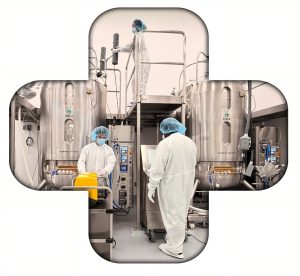 Why Early Development Decisions Determine Commercial Success
Biologic innovation often begins with urgency — advance the molecule, generate clinical data, and move efficiently through development milestones.
But what accelerates early progress does not always support long-term commercial manufacturing success.
As programs move toward Phase III and licensure, the focus shifts. The objective is no longer proof-of-concept. It is GMP-compliant, scalable, and reliable biologics manufacturing.
Designing biologics for GMP and commercial scale is not a downstream activity. It is a strategic discipline that should begin much earlier in development.
From Clinical Development to Commercial Manufacturing
Early-stage process development is typically optimized for speed and flexibility. Small batches and evolving analytical methods are often appropriate during early clinical phases.
However, as a biologic approaches commercialization, expectations change:
- Processes must demonstrate reproducibility at scale
- Analytical methods must withstand regulatory scrutiny
- Documentation must support global GMP compliance
- Facilities must be inspection-ready
At this stage, the key question becomes:
Can this biologic be manufactured consistently, compliantly, and at commercial volumes?
The risk profile shifts from scientific uncertainty to operational execution.
Designing for Commercial-Scale Biologics Manufacturing
Scaling a biologic is not simply about increasing bioreactor capacity. It requires cross-functional alignment across process development, quality systems, facilities, and regulatory strategy.
Process Robustness
Narrow operating ranges may perform adequately at small scale but introduce variability during scale-up. Robust process characterization and clearly defined control strategies reduce risk in commercial manufacturing.
Analytical & Regulatory Readiness
Analytical methods developed for early-phase studies may require additional validation for commercial release. Planning for assay validation and lifecycle management early can prevent delays during regulatory submission.
Facility & Infrastructure Alignment
Commercial biologics manufacturing demands appropriate equipment configuration, material flow, segregation controls, and documentation systems. Facility design must support long-term GMP compliance.
Quality System Maturity
As programs scale, quality systems must scale with them. Change management, deviation handling, and data governance must reflect commercial expectations.
When these elements are aligned early, tech transfer and scale-up become structured milestones — not last-minute risks.
The Risk of Delayed Commercial Planning
Deferring commercial strategy until late-stage development often creates avoidable pressure.
Organizations may face:
- Compressed tech transfer timelines
- Additional process validation requirements
- Analytical remediation under regulatory deadlines
- Supply chain adjustments late in development
While products may still reach market, execution risk increases at precisely the moment regulatory scrutiny is highest.
The final stage of development is often the most operationally demanding.
Integrating Commercial Thinking Earlier
Commercial strategy does not need to slow early development. It should strengthen it.
Key considerations include:
- Are process parameters defined with future scalability in mind?
- Is raw material sourcing sustainable for long-term supply?
- Are analytical platforms built for validation and regulatory review?
- Is tech transfer planned as a structured transition event?
Embedding commercial-scale biologics manufacturing strategy earlier improves predictability, reduces risk, and strengthens regulatory confidence.
Bridging Development and Market Readiness
At Bora Biologics, we view commercialization as a defined inflection point in the biologics lifecycle — one that requires disciplined execution, mature infrastructure, and aligned governance.
Innovation initiates progress.
Execution sustains it.
Designing biologics for GMP and commercial scale ultimately determines whether a therapy reaches patients reliably and at scale.
Now Operational: 2000L Single-Use Commercial Capacity in the U.S.
Bora Biologics’ expanded 2000L single-use capabilities support late-stage development and commercial GMP manufacturing in our San Diego FDA registered facility.