Planning Beyond Drug Substance: Connecting Biologics Manufacturing, Fill/Finish, and Commercial Supply
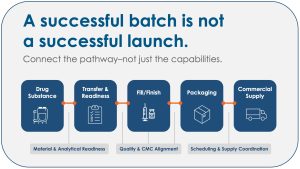
A successful drug substance batch is not a successful launch. The manufacturing strategy has to connect the two.
Your drug substance batch meets specifications. The manufacturing team has delivered. The program is moving forward.
But the fill/finish slot depends on a release date that is still uncertain. The receiving site needs additional analytical work. The shipping configuration has not been fully qualified. A packaging decision is waiting on commercial input.
Each issue may be manageable. Together, they can put the supply timeline under pressure.
The molecule has not failed. But gaps between manufacturing stages can still put supply at risk.
For biologics sponsors, this is a critical distinction. Strong drug substance manufacturing and strong fill/finish capabilities are essential—but selecting them independently does not automatically create a strong commercial supply pathway.
The strategic question is not simply:
Can each partner execute its part?
It is:
Can the entire pathway deliver when the program needs it to?
The Most Expensive Gap May Be Between Two Capable Teams
Drug substance and drug product activities are often planned as separate workstreams, with different teams, schedules, contracts, and measures of success.
That structure can work. But it creates interfaces that require deliberate management.
A drug substance team may optimize for productivity, purity, and batch release. A fill/finish team must also consider formulation behavior, component compatibility, aseptic processing, filling performance, and finished-product requirements.
Neither perspective is wrong. Neither is sufficient on its own.
Decisions made upstream can affect what happens downstream:
- Drug substance concentration and formulation can influence handling and filling.
- Freeze/thaw conditions and hold times can affect product quality and scheduling flexibility.
- Container selection and shipping configurations can influence recovery, stability, and receiving-site operations.
- Analytical methods and reference standards can affect transfer readiness and release timing.
- Batch size and yield assumptions can determine whether enough material is available for filling, testing, stability studies, and other program needs.
An upstream decision is not truly optimized if its downstream consequences have not been understood.
This is why fill/finish should not enter the conversation only when drug substance is nearly ready to ship.
Your Product Does Not Recognize Organizational Boundaries
The molecule experiences one continuous sequence of manufacturing, storage, transport, formulation, filling, and subsequent handling.
It does not recognize where one organization’s responsibility ends and another’s begins.
Sponsors should plan with the same continuity.
Consider a drug substance process that delivers higher yield but requires additional handling before filling. Or a larger batch that improves upstream economics but exceeds downstream needs, creating inventory exposure. Or a release schedule that looks achievable locally but leaves no margin for transport, receiving, and preparation before a reserved filling slot.
These are not necessarily reasons to reject a process. They are reasons to evaluate it across the full pathway.
The right question is not only, “Did we improve this manufacturing step?”
It is:
“Did we improve the product’s path to supply—or move the problem somewhere else?”
A Batch Is Not a Supply Plan
Batch-level success matters. But commercial supply requires multiple activities to work together, often under changing assumptions.
A credible plan connects:
- Drug substance manufacturing and release.
- Storage, transport, and receiving-site readiness.
- Formulation and drug product processing.
- Sterile fill/finish and component availability.
- Testing, quality review, and disposition.
- Packaging and market-specific requirements.
- Inventory strategy and future manufacturing campaigns.
The dependencies matter as much as the individual milestones.
For example, a delayed drug substance release may do more than shift shipment by a few days. It may affect a filling slot, packaging availability, or the timing of finished-product supply.
Planning each stage independently can hide those consequences until the options are limited.
Commercial readiness is not the sum of available manufacturing slots. It is the ability to coordinate the decisions between them.
One Timeline Means Managing Dependencies—Not Sharing a Spreadsheet
Putting drug substance and drug product milestones into one schedule is a useful start. It is not the same as having an integrated execution plan.
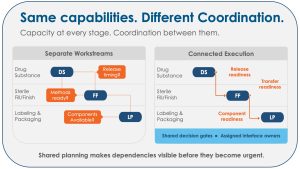
A connected plan should make clear:
- Which milestones depend on quality decisions, not just production completion.
- What must be demonstrated before material can move or be processed.
- Where analytical readiness could constrain execution.
- Which assumptions determine material requirements and scheduling.
- Who owns a cross-site issue and how it will be escalated.
- What happens if yield, release timing, or demand changes.
These questions become especially important as programs approach Phase 3, process performance qualification (PPQ), biologics license application (BLA) preparation, and launch.
Not every uncertainty can be eliminated. But uncertainty should be visible, assigned, and managed before it becomes urgent.
Quality and CMC Alignment Cannot Be Deferred to the Handoff

A shipment does not complete a technology transfer. A shared brand does not replace quality agreements. And an integrated platform does not remove the need for site-specific responsibilities and controls.
For sponsors, moving from drug substance manufacturing to drug product fill/finish can mean navigating separate quality systems, contacts, and decision processes. Bora Biologics’ shared quality umbrella supports continuity between sites, helping coordinate quality expectations and transfer requirements while maintaining each site’s responsibilities and controls.
The value of integration is the opportunity to align those requirements earlier.
That includes a coordinated chemistry, manufacturing, and controls (CMC) documentation strategy: connecting process descriptions, analytical approaches, stability considerations, validation planning, and change-control decisions across drug substance and drug product.
Without that alignment, teams can produce individually sound documentation that is difficult to reconcile across the program.
Likewise, analytical work should be coordinated wherever scientifically and operationally appropriate. The goal is not to assume that every method transfers unchanged. It is to avoid preventable duplication while identifying the method development, transfer, or bridging work the product actually requires.
The objective is a coherent manufacturing story—not simply a complete collection of documents.
The Lowest Local Cost May Not Deliver the Best Program Economics
Sponsors understandably scrutinize manufacturing prices. But a favorable price at one stage may not translate into a favorable total cost.
Additional handling, duplicated work, material losses, missed scheduling windows, and excess inventory can change the economics of an apparently efficient pathway.
A better assessment considers:
- How much usable drug product the pathway is expected to deliver.
- What material is needed beyond the intended commercial fill quantity.
- Where product losses or additional work may occur.
- How schedule changes affect cost and supply.
- How much sponsor effort is required to coordinate execution.
This shifts the discussion from the price of individual operations to the practicality of the full supply strategy.
The goal is not to make every stage look efficient in isolation. It is to make the pathway work for the product and its market.
The Power of ONE: Connecting Drug Substance Through Drug Product
Bora Biologics partners with Bora Pharmaceuticals in Maryland for sterile fill/finish and packaging, connecting commercial-scale biologics drug substance manufacturing with downstream drug product execution.
That connection starts before drug substance manufacturing is complete. By involving drug product project management early during drug substance manufacturing, Bora brings fill/finish planning into the upstream schedule—so material readiness, transfer requirements, and manufacturing timelines can be coordinated before the site-to-site handoff.
For sponsors, the benefit is a more connected transition under a shared quality umbrella, rather than having to coordinate two disconnected manufacturing relationships.
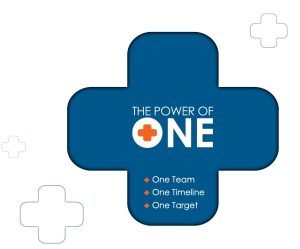 Our Power of ONE approach brings those capabilities together around the customer’s program:
- Commercial-scale drug substance manufacturing through Bora Biologics.
- Sterile fill/finish and packaging through Bora Pharmaceuticals.
- A unified CMC documentation strategy across drug substance and drug product.
- Early drug product project management involvement to align drug substance manufacturing, site-to-site transfer, and fill/finish timelines.
- Unified governance from drug substance through drug product to support clearer decisions and simpler sponsor oversight.
-
A coordinated customer-centric commercial approach, with a single agreement where appropriate for the program.
The purpose is more than convenience. It is to help reduce drug substance-to-drug product interface risk, limit avoidable rework, and support a more predictable transition toward commercial supply.
That does not mean every program follows the same development script. Complex proteins, different demand scenarios, and product-specific requirements still require scientific judgment.
It means those decisions can be addressed through a connected platform rather than left for the sponsor to reconcile between separate workstreams.
Ask About the Interface Before You Commit to the Capacity
When evaluating a manufacturing pathway, ask:
- Which drug product requirements need to inform drug substance development now?
- Are material quantities based on upstream yield—or the full downstream requirement?
- How are analytical, quality, and CMC expectations being aligned across sites?
- Who owns decisions that affect both drug substance and drug product?
- Can the plan adapt if release timing, process performance, or demand changes?
The answers reveal whether you have a collection of capabilities or a coordinated supply strategy.
Plan for the Product—not Just the Next Batch
A released drug substance batch is an important milestone. It should not be where the manufacturing strategy stops.
For sponsors moving toward pivotal development, validation, filing, or launch, the next opportunity is to connect the pathway early—while there is still time to resolve interfaces, align teams, and preserve options.
Your product needs more than successful manufacturing steps. It needs those steps to work together.
Planning a biologics program that requires drug substance manufacturing, sterile fill/finish, and commercial supply support?
Connect with Bora Biologics to discuss how the Power of ONE can help build a coordinated pathway around your molecule, your milestones, and your future supply needs.