Quality Maturity Is Commercial Readiness
 Why sponsors should evaluate how a manufacturing partner makes decisions—not just whether it passes audits.
A successful inspection is a milestone. It is not a business continuity plan.
For sponsors approaching commercialization or expanding into regulated markets, that distinction matters. A manufacturing operation can have approved procedures, completed training records, and a history of acceptable audits—and still struggle when production schedules tighten, an unexpected trend emerges, or a process moves to a new site.
Compliance establishes essential requirements. Quality maturity determines how reliably an organization operates when those requirements meet commercial reality.
That makes quality maturity more than a quality assurance concern. It is a commercial readiness issue.
Commercial Pressure Reveals What an Audit May Not
During development, teams can sometimes accommodate uncertainty through additional investigation, flexible scheduling, or intensive oversight. Commercial supply leaves less room for improvisation.
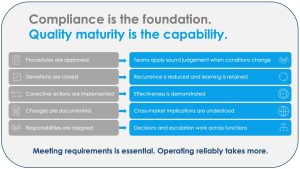 The process must perform repeatedly. Decisions must be timely and scientifically defensible. Changes must be controlled without bringing progress to a standstill. And emerging risks must become visible early enough to act—before they affect release timelines or supply continuity.
Consider a recurring deviation. Each occurrence may be investigated, documented, and closed within the required timeframe. On paper, the system is functioning.
But if the same underlying issue continues to return, closure is not the same as control.
A mature quality organization asks a harder question: What have we learned, and what has actually changed?
The difference is not more documentation. It is better organizational judgment.
Quality Maturity Lives Between the Procedures
Sponsors often assess manufacturing partners through certifications, inspection histories, technical capabilities, and available capacity. These are necessary inputs. They do not tell the whole story.
Some of the most revealing evidence comes from how a partner handles uncertainty:

- Does it recognize weak signals? Small shifts in process performance, recurring minor deviations, or repeated interventions may matter before a specification is breached.
- Does it connect information across functions? Quality, manufacturing, analytical, engineering, and supply teams should work from a shared understanding of risk—not separate versions of events.
- Does it challenge its own conclusions? A corrective action is not effective simply because it was implemented. Its effectiveness must be demonstrated.
- Does it escalate early? Sponsors need timely visibility into emerging issues, including when the full answer is not yet available.
- Does it preserve knowledge? Process rationale and lessons learned must survive personnel changes, technology transfers, and site transitions.
These behaviors are difficult to capture in a capability presentation. They become highly visible when something goes wrong.
The Most Important Conversation May Be About a Difficult Batch
When evaluating a partner, ask about an instance when process performance was unexpected—not only about a successful inspection.
What did the team notice first? Who became involved? When was the sponsor informed? How were competing hypotheses tested? What evidence supported the final decision? What changed afterward?
Confidentiality may limit the details a partner can share, but the reasoning should still be clear.
A partner that can explain how it manages a difficult decision may reveal more about commercial readiness than one that promises an uncomplicated future.
The goal is not a manufacturer that never encounters problems. It is a manufacturer that recognizes them, contains them, learns from them, and communicates responsibly.
More Markets Require More Than More Filings
Expansion into regulated markets adds complexity beyond the submission itself.
Market-specific commitments, change-notification requirements, testing and release arrangements, and supply-chain dependencies must remain aligned with day-to-day operations. A change that appears straightforward at the site level may have different consequences across approved markets.
Quality maturity helps connect those consequences before implementation—not after a discrepancy is discovered.
It also supports more useful conversations between sponsor and manufacturer: Which changes are necessary? What evidence is required? Where are the dependencies? Who owns the next decision?
This is where quality becomes a practical enabler of commercial execution, rather than a function consulted at the end.
Readiness is a Shared Responsibility
 Sponsors influence quality maturity through their own behavior: the completeness of transferred knowledge, clarity of governance, responsiveness to decisions, and willingness to address risk before it becomes urgent.
A strong manufacturing partnership makes those responsibilities explicit. It establishes not just deliverables, but how the organizations will share information, resolve disagreements, and make decisions under pressure.
Quality maturity does not guarantee regulatory approval or uninterrupted supply. But it strengthens the systems and behaviors needed to support both.
For commercial-stage sponsors, the question is therefore not simply:
“Can this partner manufacture our product?”
It is:
“Can we trust the way this partnership will operate when commercial supply depends on the next decision?”
That is the conversation worth having before the next milestone—not after the first disruption.
Preparing for commercial supply or regulated-market expansion?
Talk with Bora Biologics about the quality, technical, and operational considerations that should shape your manufacturing strategy.