
The BIOSECURE Act: What It Means for Biotech Companies and Their Supply Chains
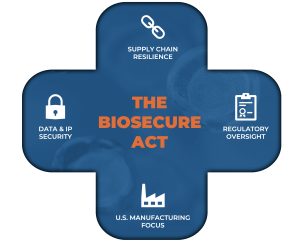
The BIOSECURE Act continues to gain attention across the U.S. life sciences industry — and for good reason.
While legislative details are still evolving, the direction is clear: the U.S. government is increasing scrutiny on biotechnology supply chains, particularly where national security considerations intersect with drug development and manufacturing.
For biotech companies, this is more than a policy discussion. It is a strategic consideration.
Why It Matters
Over the past decade, biotech supply chains have become increasingly global. Development in one region, manufacturing in another, and commercialization elsewhere became standard practice. This model drove efficiency, speed, and cost advantages.
However, geopolitical shifts and national security priorities are reshaping that landscape. The BIOSECURE Act signals a continued push toward:
- Greater transparency in biotechnology partnerships
- Increased scrutiny of certain foreign service providers
- Stronger alignment between national security and life sciences manufacturing
- Incentives for domestic manufacturing resilience
For companies in clinical or commercial stages, this may directly influence how regulators, investors, and partners assess supply chain risk.
The Strategic Implication for Biotech Leaders
Regardless of final legislative outcomes, one trend is undeniable:
Supply chain resilience is no longer optional.
Boards and executive teams are increasingly asking:
- Do we have a U.S.-based commercial supply pathway?
- How exposed are we to potential regulatory or geopolitical disruption?
- Is our CDMO strategy aligned with long-term market access requirements?
- Can we pivot quickly if policy conditions change?
For Phase 3 and commercial-stage companies in particular, these questions are becoming central to risk management and valuation.
A Structural Shift in CDMO Selection
Historically, CDMO decisions were driven primarily by speed, cost, and technical capability.
Today, additional criteria are emerging:
- Regulatory inspection readiness
- Geographic diversification
- U.S. manufacturing presence
- Long-term supply continuity
This is especially relevant for companies preparing for BLA submission or commercial launch, where late-stage supply chain changes can introduce material risk.
Looking Ahead
The BIOSECURE Act is part of a broader trend toward regional resilience in biopharma manufacturing.
Whether through legislation, investor expectations, or customer demand, the market is moving toward hybrid models that balance:
- Speed and cost efficiency
- Regulatory confidence
- Geographic diversification
- Long-term commercial sustainability
For biotech companies navigating this environment, proactive planning is key. Evaluating supply chain optionality before it becomes urgent is far less disruptive than reacting to regulatory change.
The conversation around BIOSECURE is still evolving — but the underlying theme is clear: resilience, transparency, and domestic readiness are becoming strategic differentiators.
We’ll continue to monitor developments and share insights as the landscape progresses.
BIOSECURE READINESS ASSESSMENT
Supply chain resilience is quickly becoming a board-level priority. If you are preparing for Phase 3, BLA submission, or commercial launch, now is the time to evaluate your manufacturing strategy.
Our BIOSECURE Readiness Assessment provides a focused review of:
- Supply chain exposure and geographic risk
- U.S. commercial manufacturing options
- Tech transfer feasibility and timing
Gain clarity before policy or market pressures force change.
Schedule a confidential BIOSECURE Readiness Assessment: